The Numbers Behind Atletico’s Draw with Arsenal in the Champions League

Atletico Madrid vs Arsenal was never expected to match the high drama of PSG’s thrilling Champions League semi-final against Bayern Munich, but with so much at stake, it still promised an engaging contest.
Diego Simeone’s side, trailing Barcelona by a significant 25 points in LaLiga, now see the Champions League as their only realistic route to silverware after losing the Copa del Rey final to Real Sociedad.
With domestic trophy hopes fading for both clubs, pressure is mounting. Arsenal have also seen their cup ambitions disappear after an FA Cup exit to Southampton and a Carabao Cup final defeat to Manchester City. While they remain in control of the Premier League title race, their hopes could still be overtaken if City win all their remaining matches.
In the league phase of this season’s competition, Arsenal had the upper hand in this fixture, producing a dominant display at the Emirates Stadium where they scored four goals in just 14 second-half minutes to overwhelm the Rojiblancos.
Viktor Gyökeres starred in that earlier meeting, scoring twice in a match that also marked the last occasion any side managed to keep Atletico Madrid off the scoresheet in this season’s competition.
Julian Alvarez, who has been linked with Arsenal according to transfer expert Dean Jones, arrived into the game in fine form, having already netted nine Champions League goals in the 2025/26 campaign. He was widely expected to pose a major threat to the visitors whenever chances came his way.
Alvarez made a bright start in the opening stages, underlining his attacking influence early on.
Diego Simeone made four changes from the side that eliminated Barcelona in the previous round, with Jan Oblak, Marc Pubill, David Hancko and Johnny Cardoso coming in for Robin Le Normand, Clement Lenglet, Juan Musso and Nahuel Molina.
Mikel Arteta, meanwhile, made just two adjustments to his Arsenal lineup, bringing in Ben White and Martin Odegaard in place of Eberechi Eze and Cristhian Mosquera.
Alvarez stood out as the most dangerous attacking player in the first half, registering three efforts on goal before the 30-minute mark.
The Argentine’s intelligent movement, awareness of space, and understanding of his teammates’ positioning caused constant problems for Arsenal’s defence in the early stages. His influence was a key factor behind several crucial interceptions made by Piero Hincapié.
The contrast in playing styles between the two sides was also evident.
By full-time, Hincapié’s four interceptions accounted for nearly half of Arsenal’s total of nine across the entire team.
In midfield, only Declan Rice matched that level of defensive work for Arsenal with two tackles, while Atletico’s collective intensity was reflected by eight of their players registering at least two tackles each.
This highlighted a clear contrast in playing styles between the two teams.
While Mikel Arteta has faced suggestions of being overly cautious in recent matches, Arsenal remain widely recognised for their possession-based, technical approach to build-up play. Atletico Madrid, by contrast, are known for their far more physical and combative style under Diego Simeone.
Noni Madueke stood out in Arsenal’s attacking efforts.
Attempts from Martin Ødegaard, Gabriel Martinelli and Madueke indicated that the visitors did carry a threat going forward, even though none of their efforts were on target.
Madueke, in particular, was lively in the final third. He recorded six touches inside the Atletico penalty area — the highest for Arsenal — while also completing 20 of his 22 passes and creating two chances, underlining his influence despite the lack of a decisive end product.
Atletico found it difficult to establish any real passing rhythm, but their intensity, work rate and determination remained clear throughout.
That commitment was reflected in several individual battles. Both Julian Alvarez and Ademola Lookman won the majority of their 10 one-on-one duels, while Koke, David Hancko and the energetic Marcos Llorente combined to recover possession an impressive 19 times between them.
As the first half drew to a close and both sides looked set to go into the break level, Viktor Gyökeres made the decisive impact. He won and converted a penalty to give Arsenal a crucial lead.
However, beyond the spot-kick, his involvement was limited, with just 15 touches in total. That was the fewest of any starting player on the pitch, and only two substitutes from either side registered fewer.
Given Arsenal’s perfect record of winning all 10 Champions League matches in 2025/26 when scoring first, the pressure was firmly on Atletico to respond rather than sit back and rely on counter-attacks.
Matteo Ruggeri was particularly creative before the interval, producing three chances — the highest of any player on the pitch. However, despite their attacking intent, Atletico went into the break trailing, held back by Arsenal’s defensive organisation, David Raya’s excellent goalkeeping, and their own lack of finishing efficiency.
Credit to Atletico, they returned for the second half with real intensity.
They dominated possession, holding 67% of the ball up to the hour mark, and created several early chances through Julian Alvarez, Ademola Lookman, Marcos Llorente and Antoine Griezmann (twice). Their pressure eventually led to a breakthrough moment when Ben White was penalised for handball, resulting in a 54th-minute penalty.
Alvarez confidently converted the penalty, scoring his 10th goal of the Champions League campaign, and the equaliser appeared to further energise Atletico.
From there, they pushed on strongly, with Antoine Griezmann striking the woodwork and later seeing another effort deflected wide. David Hancko and Johnny Cardoso also came close, but neither could capitalise on promising positions.
Arsenal were increasingly overrun in midfield, with Martin Zubimendi winning just one of his five duels. He, along with Declan Rice and Martin Ødegaard, was also unable to complete a single dribble during the match, highlighting Atletico’s control in central areas.
A second Arsenal penalty decision was later overturned by VAR, denying them a chance to regain the lead.
Mikel Arteta responded with a triple substitution, withdrawing Gabriel Martinelli, Noni Madueke and Viktor Gyökeres, and introducing Bukayo Saka, Gabriel Jesus and Leandro Trossard.
Despite those changes, Arsenal managed five further attempts before full-time, but none seriously tested Jan Oblak.
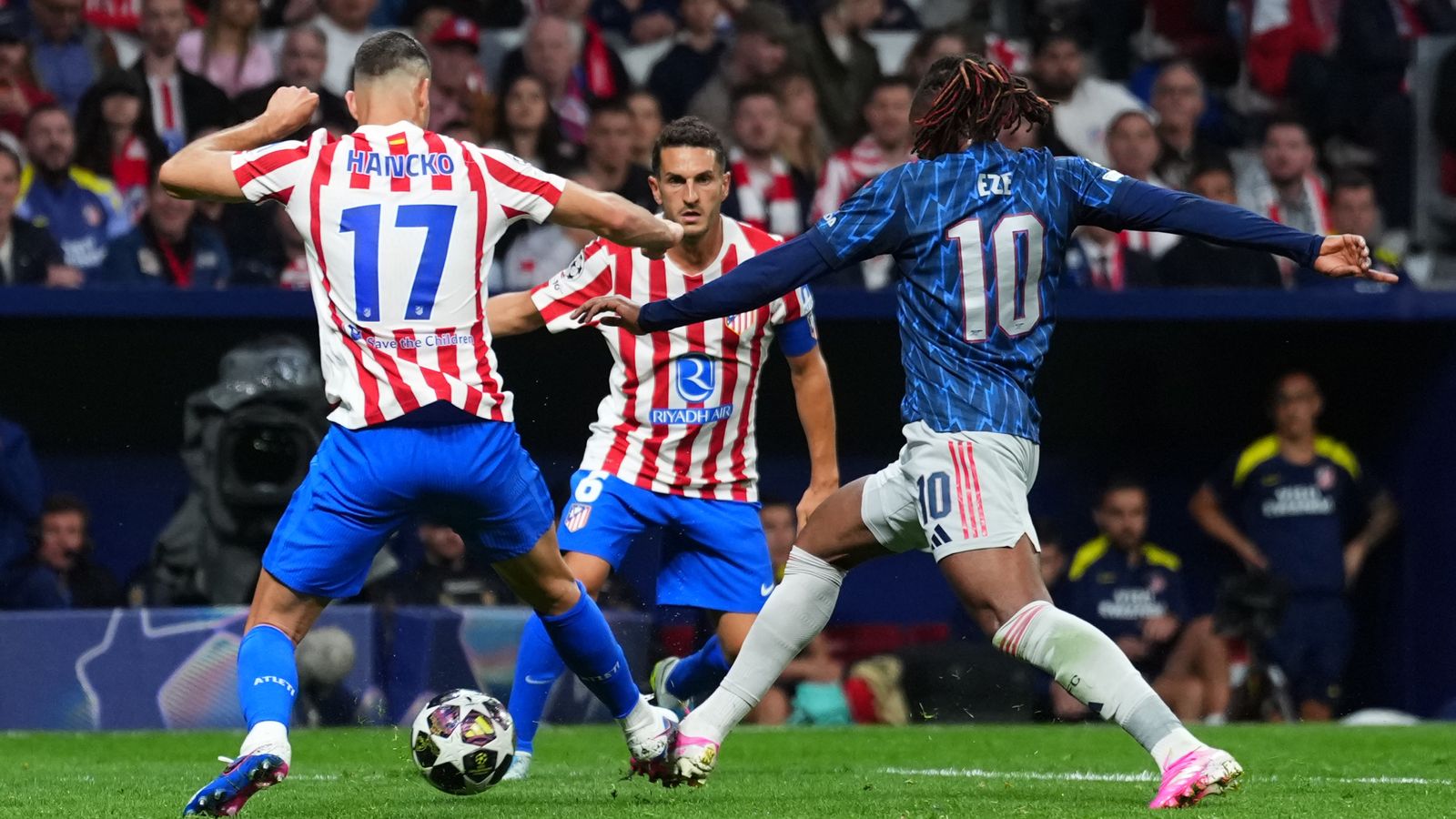
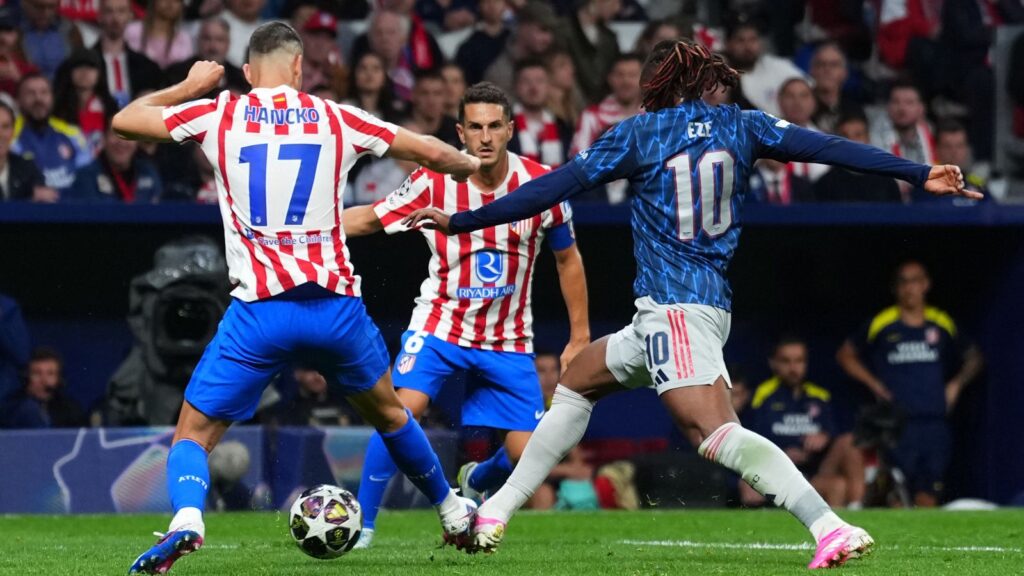
Arsenal were left frustrated when a penalty initially awarded by referee Danny Makkelie was overturned following a VAR review. Replays indicated that Eberechi Eze was clearly caught by David Hancko as he lunged in for the ball.
With the tie finely poised heading into the second leg, both sides remain level on aggregate and aware that a strong performance at the Emirates will be decisive in securing a place in the final.
Share this content: